Figshare has just announced that they're allowing embeddable content via a handy widget. This seems like a natural step to promote the dissemination of open data and self-publishing of research data. I've tried out the widget on a previous post about the evolution of voltage-gated sodium channels - link here - and it fits really well with the blog format. You can also see it below. PLOS has started using the widget seamlessly in their journal websites as well - see for example this article. They've already been using figshare to deposit supporting information for a while now.
Speaking of voltage-gated sodium channels, my former colleague Jenny Widmark and our group leader Dan Larhammar have just published a short chapter on their evolution for eLS (Encyclopedia of Life Sciences), based on our work. I've included the link to the eLS chapter below.
Phylogenetic maximum likelihood analyses of the voltage-gated sodium channel α subunit (SCNα) gene family based on amino acid sequence alignments. The sequences and alignments described in Widmark et. al. (2011) Molecular Biology and Evolution 28(1):859-71 (1) were used to re-analyze the phylogenetic relationships of vertebrate SCNα subtypes with more powerful methods.
Widmark, J., & Larhammar, D. (2013). Evolution of Voltage-Gated Sodium Channels eLS John Wiley & Sons, Ltd DOI: 10.1002/9780470015902.a0024936
Showing posts with label Biology. Show all posts
Showing posts with label Biology. Show all posts
June 18, 2013
February 21, 2012
An exercise in open science: The evolution of voltage-gated sodium channels
>> This post describes my re-analysis of the voltage-gated sodium channel α subunit (SCNA) gene family evolution, based on a previously published study. I have shared the improved results as well as all source files and datasets openly in Figshare, together with a description of the methods: link.
This is probably not my last re-analysis of the same dataset, and I'd want to encourage others to use other phylogenetic methods on our alignments, or use our alignments to analyse their own SCNA sequences.
 Last year my research group published a study on the evolution of voltage-gated sodium channel α subunits (see reference below) with me as one of the co-authors. Voltage-gated sodium channels are the proteins that permit the passage of positive charges, in this case sodium ions, across the cell membranes of neurons and thus make it possible for your nerve fibres to fire electrical signals. The α subunits are the very large proteins forming the actual pore that selects only sodium ions and allows them to pass. It's difficult to overestimate how essential they are for the function of the nervous system, and how important their evolution has been for the evolution of neuronal signaling.
Our published study used both sequence-based phylogenetic data and genomic data to clear up the muddled relationships between different subtypes of voltage-gated sodium channels in vertebrates. Us humans, and most other mammals, have ten different types of these α subunits, encoded by genes of the SCNA family. The different subtypes have acquired different properties and are expressed in different parts of the nervous system and some other tissues in the body where electrical signaling is necessary. One of the subtypes, the product of the SCN7A gene, has even evolved to such a degree that it's not a channel anymore. It's probably more like a sodium "sensor". There are also specific diseases, different types of epilepsy, seizures and paralyses, that are associated with mutations of the various subtypes.
The same gene family in true bony fishes (teleosts) encodes up to eight different subtypes, almost as many as the mammalian family. The funny evolutionary twist is that we have evolved almost the same amount of subtypes by completely different mechanisms! In tetrapods, the fleshy-limbed mostly terrestrial group that we belong to, local duplications of genes on the same chromosomes gave rise to new subtypes, while in teleost fishes it was their ancestral duplication of the whole genome that did the same on different chromosomes! You can see the difference in the image below.

Chromosome organization of the SCNA genes and some of their neighboring genes in humans and zebrafish. Each numbered line represents a different chromosome. The ten human genes are named in a series from SCN1A to SCN11A, skipping the number 6. The duplicates in teleost fish are denoted by the letters "a" and "b".
This means that when doing comparative studies, it's important to know that while all vertebrate voltage-gated sodium channels have a common origin, they're not always directly related to each other.
Using more powerful and careful methods than we'd used before, I made new evolutionary trees that agree even better with these conclusions. Most of all these new trees are better and clearer examples of the evolutionary relationships between different voltage-gated sodium channel subtypes. You can see figures of the new trees and access all the source files and datasets in Figshare.
This is probably not my last re-analysis of the same dataset, and I'd want to encourage others to use other phylogenetic methods on our alignments, or use our alignments to analyse their own SCNA sequences.
Last year my research group published a study on the evolution of voltage-gated sodium channel α subunits (see reference below) with me as one of the co-authors. Voltage-gated sodium channels are the proteins that permit the passage of positive charges, in this case sodium ions, across the cell membranes of neurons and thus make it possible for your nerve fibres to fire electrical signals. The α subunits are the very large proteins forming the actual pore that selects only sodium ions and allows them to pass. It's difficult to overestimate how essential they are for the function of the nervous system, and how important their evolution has been for the evolution of neuronal signaling. Our published study used both sequence-based phylogenetic data and genomic data to clear up the muddled relationships between different subtypes of voltage-gated sodium channels in vertebrates. Us humans, and most other mammals, have ten different types of these α subunits, encoded by genes of the SCNA family. The different subtypes have acquired different properties and are expressed in different parts of the nervous system and some other tissues in the body where electrical signaling is necessary. One of the subtypes, the product of the SCN7A gene, has even evolved to such a degree that it's not a channel anymore. It's probably more like a sodium "sensor". There are also specific diseases, different types of epilepsy, seizures and paralyses, that are associated with mutations of the various subtypes.
The same gene family in true bony fishes (teleosts) encodes up to eight different subtypes, almost as many as the mammalian family. The funny evolutionary twist is that we have evolved almost the same amount of subtypes by completely different mechanisms! In tetrapods, the fleshy-limbed mostly terrestrial group that we belong to, local duplications of genes on the same chromosomes gave rise to new subtypes, while in teleost fishes it was their ancestral duplication of the whole genome that did the same on different chromosomes! You can see the difference in the image below.
Chromosome organization of the SCNA genes and some of their neighboring genes in humans and zebrafish. Each numbered line represents a different chromosome. The ten human genes are named in a series from SCN1A to SCN11A, skipping the number 6. The duplicates in teleost fish are denoted by the letters "a" and "b".
This means that when doing comparative studies, it's important to know that while all vertebrate voltage-gated sodium channels have a common origin, they're not always directly related to each other.
Using more powerful and careful methods than we'd used before, I made new evolutionary trees that agree even better with these conclusions. Most of all these new trees are better and clearer examples of the evolutionary relationships between different voltage-gated sodium channel subtypes. You can see figures of the new trees and access all the source files and datasets in Figshare.


November 30, 2011
Two ways of looking at the same proteins: Insulin-like Growth Factor Binding Proteins
Back in June I blogged about a research paper that we had just published with myself as the lead author. The subject of our paper was the evolution of the Insulin-like Growth Factor Binding Proteins (IGFBPs), and how this family of proteins has expanded in vertebrate evolution. Yesterday I noticed that this paper, "my" paper!, now has received its very first citation! This was a my first paper as lead author, so naturally I avidly checked it out. The research paper that cites us is in press in the Journal of Biological Chemistry (reference below). While we were interested in finding as many IGFBP genes in as many vertebrates as we could, studying the characteristics of their genetic code and establishing their evolution, this study is more concerned with the biochemical structures of the actual proteins.

Molecular model of mouse IGFBP-5 (N-terminal), showing the locations of the cysteines that form disulfide bridges. Ref: M. Nili et. al. (see reference below).
September 29, 2011
Is there anything fish don't do? Tool use!
This video and story have been making the rounds on the Internet in the last few days. I just saw it yesterday and it's fascinating! For the first time (allegedly), "tool-use" in a fish has been filmed and the behavior is available for all of us to see. The fish in question is a species of wrasse observed in Palau, Choerodon anchorago or orange-dotted tuskfish.
You can see the fish digging out a clam with its pectoral fin, then carrying it over to a rock or a coral head and cracking it with a characteristic sideways motion of the head. The fish was observed doing this three times in a row, the last of which was recorded. Each event lasted less than five minutes. Here are summaries of the story from Scientific American, Science Daily and AnimalWise.
This finding is being published as a short notice in the journal Coral Reefs and joins other findings from earlier this year, published in the same journal, presenting the first photographic evidence of the same behavior in another species of tuskfish, Choerodon schoenleinii. That story was summarized in Science Now and Wired Science. In fact, there have been a handful of reports of the same behavior from different species of wrasse indicating that this might be a shared ancestral behavior in the Labridae.
Whether this constitutes "real" tool use as seen in mammals and birds, or not, will depend entirely on the kind of definition you use. That question is boring to me. But I do think it would be a mistake to equate or compare this "tool use" in fish to, for example, tool use in chimpanzees. Instead I think the interesting perspective is to put this behavior within the already known complex feeding and food seeking behaviors in fish to see in which niches "tool use" might have been beneficial.
Bernardi, G. (2011). The use of tools by wrasses (Labridae) Coral Reefs (Online First™, 20 September 2011) DOI: 10.1007/s00338-011-0823-6
Jones, A., Brown, C., & Gardner, S. (2011). Tool use in the tuskfish Choerodon schoenleinii? Coral Reefs, 30 (3), 865-865 DOI: 10.1007/s00338-011-0790-y
You can see the fish digging out a clam with its pectoral fin, then carrying it over to a rock or a coral head and cracking it with a characteristic sideways motion of the head. The fish was observed doing this three times in a row, the last of which was recorded. Each event lasted less than five minutes. Here are summaries of the story from Scientific American, Science Daily and AnimalWise.
This finding is being published as a short notice in the journal Coral Reefs and joins other findings from earlier this year, published in the same journal, presenting the first photographic evidence of the same behavior in another species of tuskfish, Choerodon schoenleinii. That story was summarized in Science Now and Wired Science. In fact, there have been a handful of reports of the same behavior from different species of wrasse indicating that this might be a shared ancestral behavior in the Labridae.Whether this constitutes "real" tool use as seen in mammals and birds, or not, will depend entirely on the kind of definition you use. That question is boring to me. But I do think it would be a mistake to equate or compare this "tool use" in fish to, for example, tool use in chimpanzees. Instead I think the interesting perspective is to put this behavior within the already known complex feeding and food seeking behaviors in fish to see in which niches "tool use" might have been beneficial.
Bernardi, G. (2011). The use of tools by wrasses (Labridae) Coral Reefs (Online First™, 20 September 2011) DOI: 10.1007/s00338-011-0823-6
Jones, A., Brown, C., & Gardner, S. (2011). Tool use in the tuskfish Choerodon schoenleinii? Coral Reefs, 30 (3), 865-865 DOI: 10.1007/s00338-011-0790-y
August 17, 2011
The "living fossil" discussion and that "living fossil" eel you might have heard of

Ref: Video still/Jiro Sakaue, Southern Marine Laboratory, Palau.
I don't like the term "living fossil". Sure, when used well it can be eye-catching in a pedagogical way, but it's still sort of vague and problematic, and used badly it's outright confusing and may reinforce misconceptions about evolution. That's why when you see it used, you often see it between quotation marks followed by an explanation motivating why the organism in question is called a "living fossil" to begin with. Today we learn about the discovery of a really striking and interesting new species of eel from Palau, Protoanguilla palau, heralded as a "living fossil" in the title of the scientific publication made available today (see reference below) as well as in most media reports.
August 12, 2011
The Atlantic cod genome is available
Great news for those of us who are interested in comparative genomics, and fish genomes in particular - yesterday the Atlantic cod genome was made public at the cod genome project website to coincide with the description of the genome, published online in advance by Nature (reference below). I've been pottering about in the genome since yesterday morning, looking for the gene families I'm researching in my own work, but the database is still quite rudimentary and tricky to use. Most of the sequences I've searched for come back in fragments, and since the genome hasn't been mapped to chromosomes in the database, it's difficult to find out where in the genome individual sequences are, and to "get to know the neighborhood" of the sequence you're interested in, which is essential for comparative genomics. Thankfully it will (probably) get a more user-friendly interface soon, when it becomes integrated with the Ensembl genome browser, where the other five sequenced fish genomes are already available.
I also made this illustration for my collection of genome species.

The Atlantic cod, Gadus morhua
The basic genome stats reveal a pretty standard vertebrate genome, if there is such a thing. The total (haploid) size is estimated at approx. 830 million base pairs, a bit lower than previous estimates, and the number of identified genes is 22,154 (20,095 protein coding). The closest related fish species with a sequenced genome is the three-spined stickleback, Gasterosteus aculeatus, with a genome of approx. 446 million base pairs and 20,787 identified genes. The best studied fish genome, that of the zebrafish Danio rerio is quite a bit longer, with about 1.5 billion base pairs, but the gene content is similar with about 26,000 identified genes.
July 22, 2011
A quick Mendel follow-up
As a footnote to my previous post about Gregor Mendel, I offer these interesting Google NGrams.
To start off, we plot the terms "Gregor Mendel", just "Mendel", "Mendelian" as well as the genus of the garden pea Mendel worked with, "Pisum".

Not surprisingly, the years 1866 and 1900 (or there around) stand out markedly.
To start off, we plot the terms "Gregor Mendel", just "Mendel", "Mendelian" as well as the genus of the garden pea Mendel worked with, "Pisum".
Not surprisingly, the years 1866 and 1900 (or there around) stand out markedly.
July 20, 2011
Remembering Gregor Mendel
Today is the 189th anniversary of the birth of scientist Gregor Mendel, as commemorated by today's doodle on google.com. It's one of their better ones, I think.
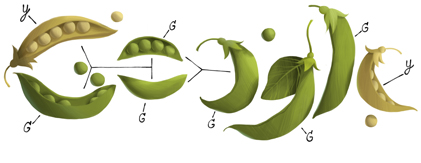
The picture shows the plant that Mendel has become famous for, the common pea Pisum sativum, but it also cleverly shows an illustration of the "laws" that he discovered. We can see the traits green (dominant) and yellow (recessive) color be passed on through two generations in the predictable proportions dictated by Mendelian inheritance. This is good old basic school biology, and most of us must be familiar with Mendel from that context. The Guardian also commemorates the day and provides a little bit of background.
Much has been said, and probably remains to be said, about Mendel's role as "father of genetics" and whether or not he predicted the existence of genes. I always think it's fun to go back to the original source of things, so here we have the relevant piece from Mendel's 1866 paper Versuche über Pflanzen-Hybriden or Experiments in Plant Hybridization, which was first read to the Natural History Society in Brünn (now Brno in the Czech Republic) the year before. I recommend this site for insightful comments on and facts about Mendel's original paper.
The picture shows the plant that Mendel has become famous for, the common pea Pisum sativum, but it also cleverly shows an illustration of the "laws" that he discovered. We can see the traits green (dominant) and yellow (recessive) color be passed on through two generations in the predictable proportions dictated by Mendelian inheritance. This is good old basic school biology, and most of us must be familiar with Mendel from that context. The Guardian also commemorates the day and provides a little bit of background.
Much has been said, and probably remains to be said, about Mendel's role as "father of genetics" and whether or not he predicted the existence of genes. I always think it's fun to go back to the original source of things, so here we have the relevant piece from Mendel's 1866 paper Versuche über Pflanzen-Hybriden or Experiments in Plant Hybridization, which was first read to the Natural History Society in Brünn (now Brno in the Czech Republic) the year before. I recommend this site for insightful comments on and facts about Mendel's original paper.
June 30, 2011
The mighty coelacanth

I've added the above illustration of a Coelacanth (Latimeria chalumnae) to my collection of illustrations together with one I had already made of a lungfish (open image). If you like you can download both high-res TIF-files here. The same Creative Common license applies as described under the "Download Illustrations" tab above.

I was prompted to add the coelacanth after reading a recent fascinating article about the secretive lives of these marvelous fish (via Deep Sea News) by Dr. Hans Fricke and co-workers. The article summarizes decades of study of the Latimeria population outside the island Grande Comore in the Indian ocean.
Latimeria live in large overlapping home ranges that can be occupied for as long as 21 years. Most individuals are confined to relatively small home ranges, resting in the same caves during the day. One hundred and forty five coelacanths are individually known, and we estimate the total population size of Grande Comore as approximately 300–400 adult individuals. <...> We estimate that the mean numbers of deaths and newcomers are 3–4 individuals per year, suggesting that longevity may exceed 100 years.
I'm astounded and my imagination is fueled by the intimate detail and vivid language with which the individual lives of these fishes is described! From the re-sighting of known individuals across several decades, the description of their cave-dwellings, which their share in family groups, their nocturnal hunting habits, and how they sometimes move outside of their familiar home-ranges. You can also read this recent interview with Fricke in Wired.
June 27, 2011
"Warm-blooded" dinosaurs and "warm blooded" fish*
At 80beats (@Discover blogs) there is a post about a method of inferring the body temperature of large dinosaurs by looking at the temperature that would be needed for the enamel of Brachiosaurus and Camarasaurus teeth to form. The post references a recent study published in Science. The conclusion is that big dinosaurs were as warm as mammals, but that's not to say that they had the same temperature regulation as mammals.
It's always been a pet peeve of mine to note when the terms "warm-blooded" and "cold-blooded" are used indiscriminately - in popular use they are incredibly widespread - or even when the more scientific terms endothermy and ectothermy are put against each other. This doesn't actually give the right view of the diverse temperature-regulation strategies that different animals can have. At Deep Sea News, one of my favourite blogs, there is a great post about those strategies that are somewhere in between the notions of warm- and cold-bloodedness, highlighting the really interesting strategies in pelagic fish*, such as lamnid sharks, tunas, billfishes and several others.
Considering this, it's certainly not far-fetched to assume that "warm-bloodedness" has evolved several times in land-living tetrapod vertebrates as well. To me there is little doubt that the small theropod dinosaurs that birds arose from were able to regulate their body temperature internally, but perhaps sauropods, or some other dinosaur groups, were able to do it as well to some extent.
* I use the term fish very loosely here. Lamnid sharks are as related to us humans as they are to tunas and billfishes.
Here, we used clumped isotope thermometry to determine body temperatures from the fossilized teeth of large Jurassic sauropods. Our data indicate body temperatures of 36 to 38°C, which are similar to most modern mammals. This temperature range is 4 to 7°C lower than predicted by a model that showed scaling of dinosaur body temperature with mass, which could indicate that sauropods had mechanisms to prevent excessively high body temperatures being reached due to their gigantic size.
It's always been a pet peeve of mine to note when the terms "warm-blooded" and "cold-blooded" are used indiscriminately - in popular use they are incredibly widespread - or even when the more scientific terms endothermy and ectothermy are put against each other. This doesn't actually give the right view of the diverse temperature-regulation strategies that different animals can have. At Deep Sea News, one of my favourite blogs, there is a great post about those strategies that are somewhere in between the notions of warm- and cold-bloodedness, highlighting the really interesting strategies in pelagic fish*, such as lamnid sharks, tunas, billfishes and several others.
One important pattern that emerges from these observations is that body-warming is not a taxonomic thing: it has evolved several times in several different lineages, at least twice for sharks and once each for rays, tuna/billfish and opah. Rather, body warming is an ecological thing because it occurs in many species that are not related but all share pelagic migratory habits. Doubtless a closer look at other pelagic species will show that it has evolved in quite a few other species of the open ocean too.
Considering this, it's certainly not far-fetched to assume that "warm-bloodedness" has evolved several times in land-living tetrapod vertebrates as well. To me there is little doubt that the small theropod dinosaurs that birds arose from were able to regulate their body temperature internally, but perhaps sauropods, or some other dinosaur groups, were able to do it as well to some extent.
* I use the term fish very loosely here. Lamnid sharks are as related to us humans as they are to tunas and billfishes.
June 07, 2011
IGFBP evolution: An interesting case of gene family expansion and retention
Or: How I really should have come up with a better title.
A small announcement: I have an article out as a first author in this month's issue of the journal Endocrinology. It's a nice journal and we spent a long time working on the manuscript so I'm very pleased that it's out. Here's a Worlde word cloud of the whole article... pretty interesting. It sums everything up pretty well actually. It's all about the evolution of the Insulin-like Growth Factor Binding Protein family of genes, or IGFBPs.

Click to see larger.
Why is it worth studying the evolutionary history of this particular gene family you might ask? It's not very well known, generally, and I bet very few know about its functions or that some members seem to be involved in certain types of cancer, for instance. Many times these gene families disappear behind esoteric acronyms and convoluted webs of functional interactions that only the initiated understand, and it's difficult to generate some sort of general interest in them. It all becomes a bit dry. But when you look a bit closer, many "obscure" (at least to the general audience) genes and proteins have a really interesting evolutionary story to tell, something that goes beyond the mere evolution of their gene sequences.
A small announcement: I have an article out as a first author in this month's issue of the journal Endocrinology. It's a nice journal and we spent a long time working on the manuscript so I'm very pleased that it's out. Here's a Worlde word cloud of the whole article... pretty interesting. It sums everything up pretty well actually. It's all about the evolution of the Insulin-like Growth Factor Binding Protein family of genes, or IGFBPs.
Click to see larger.
Why is it worth studying the evolutionary history of this particular gene family you might ask? It's not very well known, generally, and I bet very few know about its functions or that some members seem to be involved in certain types of cancer, for instance. Many times these gene families disappear behind esoteric acronyms and convoluted webs of functional interactions that only the initiated understand, and it's difficult to generate some sort of general interest in them. It all becomes a bit dry. But when you look a bit closer, many "obscure" (at least to the general audience) genes and proteins have a really interesting evolutionary story to tell, something that goes beyond the mere evolution of their gene sequences.
May 31, 2011
Turn off the lights and let melatonin run free
>> I started the following post about melatonin sometime in March to coincide with my lecture on biological rhythms on our undergrad neurobiology course. But I got really busy and then really sick so I never actually finished it. Here it is then at last.

An all too common sight, at least at my place. This is my Mac glaring. But how is our exposure to low-intensity artificial light before bedtime affecting our sleep cycle?
Twice every year I lecture to undergraduate students in biology and biomedicine about biological rhythms, specifically about circadian rhythms - how the brain regulates your daily cycle of sleep and wakefulness. In this process the small suprachiasmatic nuclei (SCN henceforth) in your hypothalamus and the hormone melatonin, secreted from your pineal gland, play very important roles. The SCN is the "internal clock" of your brain and receives light input from the eyes in order to "reset the clock" every morning, signaling that a new day has started. So daylight itself serves as a signal for the brain that it's daytime and we need to be awake and alert, as far as possible.
One of the things I tell my students that usually raises some eyebrows is that even quite low-intensity light, comparable to the illuminance from a computer or television screen, as seen above, can affect the brain and shift the circadian rhythm significantly. This knowledge goes back to experiments carried out in the mid 90's and raises questions as to how artificial light, such an obvious and constant component of our environment, is affecting our day-night cycle.
In a recently published article in the Journal of Clinical Endocrinology (reference 1 below) a team of researchers has shown indirectly that it's the interplay between the SCN and melatonin secretion, so essential to the regulation of nighttime behaviors, that is affected by the artificial light in our environment.
An all too common sight, at least at my place. This is my Mac glaring. But how is our exposure to low-intensity artificial light before bedtime affecting our sleep cycle?
Twice every year I lecture to undergraduate students in biology and biomedicine about biological rhythms, specifically about circadian rhythms - how the brain regulates your daily cycle of sleep and wakefulness. In this process the small suprachiasmatic nuclei (SCN henceforth) in your hypothalamus and the hormone melatonin, secreted from your pineal gland, play very important roles. The SCN is the "internal clock" of your brain and receives light input from the eyes in order to "reset the clock" every morning, signaling that a new day has started. So daylight itself serves as a signal for the brain that it's daytime and we need to be awake and alert, as far as possible.One of the things I tell my students that usually raises some eyebrows is that even quite low-intensity light, comparable to the illuminance from a computer or television screen, as seen above, can affect the brain and shift the circadian rhythm significantly. This knowledge goes back to experiments carried out in the mid 90's and raises questions as to how artificial light, such an obvious and constant component of our environment, is affecting our day-night cycle.
In a recently published article in the Journal of Clinical Endocrinology (reference 1 below) a team of researchers has shown indirectly that it's the interplay between the SCN and melatonin secretion, so essential to the regulation of nighttime behaviors, that is affected by the artificial light in our environment.
May 07, 2011
Update/A melatonin NGram
March and April disappeared in a daze and didn't lend me much time to spend on blogging. Finishing my teaching and course assistant duties for our undergraduate neurobiology course while re-working and re-submitting a research paper (now accepted in Endocrinology) took up most of March. Then to top things off I contracted a nasty Mycoplasma infection that left me floored with pneumonia for three weeks, including three days of hospitalization, so there went most of April. And the start of the year is a busy time for me as it is! I'm still a bit off-colour, but back to work!
I had started a big post about melatonin sometime in March to coincide with my lecture on biological rhythms on our neurobiology course, but as stuff happened I never actually finished it. As things have it though, I was asked to cover for another teacher lecturing last week about melatonin and the pineal gland for second term medical students, so I got a reason to re-visit melatonin and the blog post. I hope to have it up soon, but I haven't recovered completely and I'm still taking it easy with my work load so blogging is not really a priority right now. But as a short preface to that post, I thought we could take a look at what information we can extract about melatonin and the pineal gland from Google NGrams.

Melatonin is a hormone related to the neurotransmitter serotonin. Most people may have heard about it in the context of jet-lag or insomnia and perhaps different supplements or medications one might take to counteract them. Indeed melatonin is secreted when it's dark by the pineal gland in the brain as a general "night-time signal", although it doesn't stimulate sleep by itself.
We can see very clearly in the ngram above that "melatonin", "pineal gland" as well as the general term "pineal" have had a clear rise since the start of the 1960's. This makes perfect sense since melatonin was first isolated in 1958 from cow pineal glands. It was named and some of its effects were described in a 1960 paper by the same researchers. However, it was already known since the start of the 20th century that pineal gland extracts had some biological effects, before the hormone was isolated. This is detectable in another ngram, but could it also be related to the sharp peak in the term "pineal" that we see in the first decades of the 1900's in the ngram above?
The terms "pineal" and "pineal gland" go back quite far, reflecting the fact that the pineal gland has been known anatomically, and to some extent functionally, for quite a long time. The term "pineal body" is a bit of a curiosity since you often see it in old literature, but it doesn't seem to be as old or to reach the same prominence as "pineal gland" at all, which is surprising, at least to me. I thought that "pineal body" would be the older term and that it was eventually replaced by "pineal gland". Not so apparently.
I had started a big post about melatonin sometime in March to coincide with my lecture on biological rhythms on our neurobiology course, but as stuff happened I never actually finished it. As things have it though, I was asked to cover for another teacher lecturing last week about melatonin and the pineal gland for second term medical students, so I got a reason to re-visit melatonin and the blog post. I hope to have it up soon, but I haven't recovered completely and I'm still taking it easy with my work load so blogging is not really a priority right now. But as a short preface to that post, I thought we could take a look at what information we can extract about melatonin and the pineal gland from Google NGrams.
Melatonin is a hormone related to the neurotransmitter serotonin. Most people may have heard about it in the context of jet-lag or insomnia and perhaps different supplements or medications one might take to counteract them. Indeed melatonin is secreted when it's dark by the pineal gland in the brain as a general "night-time signal", although it doesn't stimulate sleep by itself.
We can see very clearly in the ngram above that "melatonin", "pineal gland" as well as the general term "pineal" have had a clear rise since the start of the 1960's. This makes perfect sense since melatonin was first isolated in 1958 from cow pineal glands. It was named and some of its effects were described in a 1960 paper by the same researchers. However, it was already known since the start of the 20th century that pineal gland extracts had some biological effects, before the hormone was isolated. This is detectable in another ngram, but could it also be related to the sharp peak in the term "pineal" that we see in the first decades of the 1900's in the ngram above?
The terms "pineal" and "pineal gland" go back quite far, reflecting the fact that the pineal gland has been known anatomically, and to some extent functionally, for quite a long time. The term "pineal body" is a bit of a curiosity since you often see it in old literature, but it doesn't seem to be as old or to reach the same prominence as "pineal gland" at all, which is surprising, at least to me. I thought that "pineal body" would be the older term and that it was eventually replaced by "pineal gland". Not so apparently.
February 12, 2011
Happy Darwin Day! Mockingbirds and Darwin's original thought
It's Darwin day! The anniversary of the old man's birthday (202nd this year) and a great opportunity to dig up some piece of Darwiniana and celebrate evolution!

Hood mockingbird, endemic to Española island, Galapagos. Ref: Wikimedia Commons.
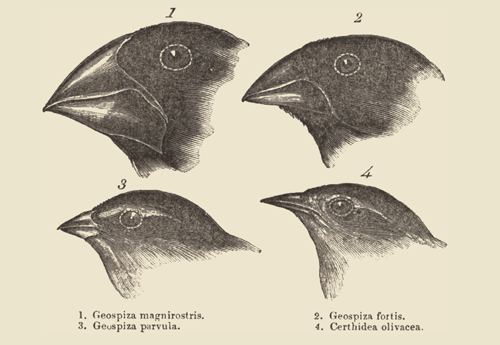
Darwin's Galapagos finches and their differing beaks (see image here) are often credited as the original inspiration for Darwin's theory of evolution through natural selection. It's true that he brought many specimens of finches back from the Galapagos, and that they subsequently received a lot of attention in his scientific work and in "On the Origin of Species", but what many people don't know is that it was in fact a different group of birds that inspired the original thought: Mockingbirds, or Tencas in Spanish. Thanks to the wonders of the Internet, all of Darwin's writings are available online and we can go looking in his notebooks for this original thought in his own handwriting.
Hood mockingbird, endemic to Española island, Galapagos. Ref: Wikimedia Commons.
.jpg)
Darwin's Galapagos finches and their differing beaks (see image here) are often credited as the original inspiration for Darwin's theory of evolution through natural selection. It's true that he brought many specimens of finches back from the Galapagos, and that they subsequently received a lot of attention in his scientific work and in "On the Origin of Species", but what many people don't know is that it was in fact a different group of birds that inspired the original thought: Mockingbirds, or Tencas in Spanish. Thanks to the wonders of the Internet, all of Darwin's writings are available online and we can go looking in his notebooks for this original thought in his own handwriting.
February 02, 2011
Oxytocin, ethnocentrism and evolution (pt. 2)
>> Go here for part 1.
I didn't want to risk making my previous post too long, and I wanted to keep it focused on "hormonal determinism", so I set aside a whole branch of my commentary on the link between the hormone oxytocin and ethnocentrism for another post. The findings I comment on were presented by De Dreu and co-workers in the latest edition of PNAS (see reference below).
So, today I want to talk briefly about bad evolutionary arguments.
I didn't want to risk making my previous post too long, and I wanted to keep it focused on "hormonal determinism", so I set aside a whole branch of my commentary on the link between the hormone oxytocin and ethnocentrism for another post. The findings I comment on were presented by De Dreu and co-workers in the latest edition of PNAS (see reference below). So, today I want to talk briefly about bad evolutionary arguments.
January 24, 2011
Oxytocin, ethnocentrism and "hormonal determinism"
>> Go here for part 2.
There is an inordinate readiness, both within scientific circles and in popular scientific understanding, to ascribe direct causation to the actions of hormones, especially when it comes to moods and behaviors. For example, consider how you’d usually interpret the common expression “being hormonal”. I consider the thought that hormones somehow “control” our moods and behaviors a falsehood; a popular misunderstanding or oversimplification that hinders the understanding of what’s actually going on. There is just as little motivation to call a hormone the “love hormone”, the “stress hormone” or the “sleep hormone” as there is calling a gene the “gay gene” or the “god gene” et c. The idea that in fact there is no one gene for property X, Y or Z has become pretty pervasive now, and I think it’s time the same thing happened for the actions of hormones.
Within this context, I want to use as an example a newly published study in PNAS that links the actions of the neurotransmitter and hormone oxytocin to ethnocentrism – the tendency to view one’s own group, the in-group, as more important or superior to other groups.

Molecular structure ofhuman placental mammal, some marsupial, platypus, ratfish and elephant shark oxytocin.
Perhaps more than any other hormone, oxytocin has become the perfect example of the kind of “hormonal determinism” that I mention above: no doubt because the study of oxytocin is a very active field and because it’s been linked to some very fascinating behaviors.
There is an inordinate readiness, both within scientific circles and in popular scientific understanding, to ascribe direct causation to the actions of hormones, especially when it comes to moods and behaviors. For example, consider how you’d usually interpret the common expression “being hormonal”. I consider the thought that hormones somehow “control” our moods and behaviors a falsehood; a popular misunderstanding or oversimplification that hinders the understanding of what’s actually going on. There is just as little motivation to call a hormone the “love hormone”, the “stress hormone” or the “sleep hormone” as there is calling a gene the “gay gene” or the “god gene” et c. The idea that in fact there is no one gene for property X, Y or Z has become pretty pervasive now, and I think it’s time the same thing happened for the actions of hormones. Within this context, I want to use as an example a newly published study in PNAS that links the actions of the neurotransmitter and hormone oxytocin to ethnocentrism – the tendency to view one’s own group, the in-group, as more important or superior to other groups.
Molecular structure of
Perhaps more than any other hormone, oxytocin has become the perfect example of the kind of “hormonal determinism” that I mention above: no doubt because the study of oxytocin is a very active field and because it’s been linked to some very fascinating behaviors.
December 07, 2010
Falsehoods associated with the arsenic-thriving bacteria story: What it is and what it isn't
>> My previous post was more of a summary of what the reporting of the "NASA arsenic-thriving bacteria" story looked like from my perspective in the wake of the massive Internet onslaught of information. In this post I want to talk about how the style of communication that drove this story has lead to the dissemination of falsehoods or misconceptions that hinder a proper understanding of biology in general, regardless of the validity of the actual findings.
December 03, 2010
My summary of NASA's arsenic-thriving bacteria story
Almost instantly after coming home from work yesterday, I noticed a steady stream of mentions of a mysterious and hugely hyped NASA press conference scheduled for later in the day trickling in via Facebook, Twitter, blogs and news sites. I got excited, but also a bit confused. NASA's announcement seemed spectacular enough:
After much speculation, what we all now know was revealed at the press conference:

Source: xkcd. "According to a new paper published in the journal Science, reporters are unable to thrive in an arsenic-rich environment."
A discovery that according to NASA means that "the fundamental knowledge about what comprises all known life on Earth" has changed and that "the definition of life has just expanded". Hyperbolic much? The paper that describes these new findings was published in advance yesterday in Science, find the link at the bottom of the post, and there are indications that associated papers with more details will be published in the coming months.
It's been exciting to follow the reporting pretty much directly as it's happened and I've been Tweeting and Facebooking the story unfolding almost in real time since yesterday. All in all this story has been a great exercise in observing how online science reporting works and how blogs and social media works within this context.
By this time yesterday the furore was on:
NASA will hold a news conference at 11 a.m. PST on Thursday, Dec. 2, to discuss an astrobiology finding that will impact the search for evidence of extraterrestrial life.
After much speculation, what we all now know was revealed at the press conference:
Researchers conducting tests in the harsh environment of Mono Lake in California have discovered the first known microorganism on Earth able to thrive and reproduce using the toxic chemical arsenic. The microorganism substitutes arsenic for phosphorus in its cell components.
Source: xkcd. "According to a new paper published in the journal Science, reporters are unable to thrive in an arsenic-rich environment."
A discovery that according to NASA means that "the fundamental knowledge about what comprises all known life on Earth" has changed and that "the definition of life has just expanded". Hyperbolic much? The paper that describes these new findings was published in advance yesterday in Science, find the link at the bottom of the post, and there are indications that associated papers with more details will be published in the coming months.
It's been exciting to follow the reporting pretty much directly as it's happened and I've been Tweeting and Facebooking the story unfolding almost in real time since yesterday. All in all this story has been a great exercise in observing how online science reporting works and how blogs and social media works within this context.
By this time yesterday the furore was on:
November 24, 2010
"Origin" day: let's celebrate evolutionary trees
The big celebration was last year, but there's no reason why we shouldn't remember that today it's been 151 years since the publication of Darwin's On the Origin of Species by Means of Natural Selection. The contribution to science presented in "Origin" is of course always recognized, and it's often mentioned how clearly and methodologically Darwin presented his arguments; but not much is said about how beautifully "Origin" is written and about how skillfully the language is used to paint pictures in the mind of the reader. Take for instance this little paragraph from the summary to chapter IV. It's one of my absolute favourite passages from the book.
It's probably the most accurate as well as beautiful, and therefore best, description of evolution and common origin that there ever will be.
As buds give rise by growth to fresh buds, and these, if vigorous, branch out and overtop on all sides many a feebler branch, so by generation I believe it has been with the great Tree of Life, which fills with its dead and broken branches the crust of the earth, and covers the surface with its ever-branching and beautiful ramifications.
It's probably the most accurate as well as beautiful, and therefore best, description of evolution and common origin that there ever will be.
November 18, 2010
Is there anything fish don't do!? Mucus-feeding and prolactin
 Much of my work involves studying fish genomes. Over time I've gotten to know them pretty well and I can only conclude that fish are incredible and inordinately interesting creatures. Unfortunately fish have an undeservedly low standing in the eyes of the general public, as well as many researchers in more mammal-oriented fields, often being referred to as "lower vertebrates" in the great evolutionary story that led to "higher vertebrates" like mammals. In fact, more than half of all vertebrate species are fish, not "higher vertebrates", and fish encompass the great majority of all vertebrate diversity. In most senses fish are the "typical" vertebrates. Their origin set the whole stage for vertebrate development, anatomy and physiology and the fair view of vertebrate evolution should be that reptiles, birds and mammals, basically everything that lives on land, are a subgroup of highly specialized fish, an interesting "side-step" rather than the "crown" of evolution.
 So why this preface in defense of fish? I have found a little story that more than anything I've read lately highlights the deep connection between fish and mammals and does a very good job at blurring the distinction between what's considered typically mammal and what fish are capable of. Plus, it relates to my own research.

Discus fish (Symphysodon aequifasciatus). Ref: Flickr.
Behold the discus fish.
Subscribe to:
Posts (Atom)