March 30, 2008

I'll tell you why

I got this (anonymous) comment to one of my recent posts countering creationist claims.

But why so terribly arrogant? If you believe you are right, some humility would make it better. The way it is now, it appears to be along the line of "when the arguments are weak, speak louder".

This is a fairly common response to vocal scientists countering any kind of pseudoscientific claims. I see it over and over and on occasion, like now, I have it aimed at myself. First of all it's really rather tiring and, just for the record, I don't think my retort was very arrogant at all. But putting that aside, it's the sort of critique from the peanut gallery that has little validity to the question at hand.

If there are two mutually incompatible views, they cannot possibly both be right. When one of them is nothing but misleading illiterate nonsense, ignorant distortion of facts or outright dismissal of them, it just doesn't merit the kind of "humble" and respectful response advocated by those who feel scientists are too arrogant. In this case, the kind of creationism I countered in my posts deserves nothing but the ridicule and severe rebuke it got. To approach it "humbly" would be to play right into the creationists' hands. It would be to concede that both views are equal and deserve equal attention and respect and that they play on an even field, which is 100% not the case. True humility is to approach questions of science unprejudiced and objectively, which creationists most certainly don't. Who are the arrogant ones?

As I wrote in my retort's concluding remarks;

This [creationism] is not about challenging science. This is not about wanting to bring science forward. This is not about one scientific view arguing with another. It's so very easy to forget that. This is about religious proselytes wanting to destroy a product of rational thought because it challenges their deeply held world-views. For all the science that is involved, for all that I have written in these entries, in the end this is about fanatics wanting to tell us all how we should lead our lives because they patronizingly feel that they have the moral authority to do so. No scientific theory pretends to do the same. The mere thought is utterly ridiculous. But by arguing like this, creationists want to take down evolutionary theory to their playing field. It's important that we don't lose sight of that.

So really, who are the arrogant ones?

Creationists thrive on the "when the arguments are weak, speak louder"-argument and they love nothing more than playing the underdog card whenever they can. Unfortunately a large portion of the general public plays along with their dishonest outcries for humility. When I said that the critique presented in the above quoted comment was not valid to the question at hand, I meant it, but that doesn't mean to say that I don't take it seriously. It is of course unfortunate if the scientific rebukes are seen as arrogant by the general public and if they only reinforce the view of creationists as underdogs. This is often coupled with the fact that scientists speak out from a position of authority, which in any situation is readily mistaken for arrogance. But the solution is definitely not to concede to their tactics and give the impression that science and creationism offer equally valid explanations. The solution is to bridge the disconnect between science and scientific thinking and the general public. It's maybe in that department that those of us who vehemently rebuke pseudoscientific claims have failed. But ultimately dreck is dreck and it needs to be called out on it, forcefully and vocally.

Swedish blog tags: ,
Technorati tags: ,

March 10, 2008

Retort to a creationist lecture pt. 3

Blogging on Pseudo-Scientific Douche-BagsThis is the third and last post in a series examining the lecture given by creationist author Anders Gärdeborn this past February 14 at Uppsala Universitet, by invitation from evangelical christian student organization Credo.

So finally I get to post the last part of my retort. Most of it has been done for quite a while, I just needed a little time to finish off the very last part. The other posts in the series have been:

First thoughts on yesterday's creationist lecture here in Uppsala
Retort to a creationist lecture pt. 1
Retort to a creationist lecture pt. 2

I'll now continue reviewing Gärdeborn's presentation of so called scientific evidence against evolution. Concluding my examination with what I think are the two most interesting fallacies creationists make - the distinction between "microevolution"/"macroevolution" and the concept of "biological information".

Evolution "within kinds"

In yet another line of misleading statements about evolution, Gärdeborn means to say that "evolutionists" have drawn conclusions from the existing biological diversity that are unreasonable. He wants to separate the "how" and the "why" in science and says that we would probably agree as far as the "how" goes, it's evolutionary theory's "why" he has a problem with. In other words he means to say that in the descriptive study of the diversity of organisms and organismal complexity we have taken too many liberties when drawing conclusions as to how the diversity and complexity have come about. He gives an example: "Bacteria become resistant, therefore we come from bacteria". Gärdeborn might think that this is a pithy point with rhetorical finesse, but I have a hard time imagining a clunkier or more confused distortion of scientific thought, much less a more willfully mean-spirited one.

Gärdeborn cannot deny that some biological change takes places, but that it happens through natural selection acting on diversity is to him "only a theory". That all life has a common ancestry he calls a "philosophy". That last remark merits a little sidetrack. All organisms on earth, that we know of, have the same nucleic acids in their DNA as well as the same orientation on their amino acids, one out of two possible. This and some other well-known properties of life makes the scenario of one common ancestor the most likely one by far.

Back to the point. It's not surprising that creationists recognize some form of evolution. After all, there are many examples of biological change through evolutionary processes that lie within the time frames that are easily manageable to our thought. These are difficult to deny, even for creationists. Examples are how bacteria become resistant to antibiotics and how we have bred different breeds of dogs. The advocates of creationism have even made up a word for these more visible processes - "microevolution" - one assumes to avoid the concession of calling it just evolution, quite simply. It's quite puzzling that somehow it's allowed for evolutionary theory to explain how a poodle and a German shepherd had a common ancestor, but not how humans and chimpanzees could have had the same. The criteria for this division have no scientific grounds whatsoever. "Microevolution" and "macroevolution" are the same thing.

What's remarkable about Gärdeborn's presentation is how far he's ready to extend "microevolution" into time frames that are well within the realms of the "macroevolution" that creationists so categorically negate. He describes an evolution "within kinds" caused by some sort of pre-programmed "genetic potential" that he fails to describe more closely. God created the "kinds" and after the deluge, when they repopulated earth, they diversified into the species we observe today. (By the way, this is his explanation of how two of every animal could fit in the ark. They were two of every original "kind", not species.) Gärdeborn affirms assuredly that in nature "animals exist within determined groups" and gives canids as an example. He says that there are "waterproof bulkheads" between the groups ("there are no half-people") but that variation can arise within the groups through "microevolution". It would be interesting to know why such a large and diverse group as the canids can be seen as a waterproof grouping while such a small one as the apes cannot. At the core of this reasoning is the fallacy of thinking that evolution has happened as transitions between the species of today.

The canids include dogs, wolves, foxes, coyotes, dingos, jackals, African wild dogs and a variety of other species. According to modern science, they arose from the miacides, a sort of dog- and bear-like carnivores, about 40 million years ago, relatively early in the evolution of mammals. This is supported with fossil, morphological, genetic and protein data. The evolution of the great apes goes back approximately 14 million years but still their (or I should say, our) evolution is regarded as an unacceptable "macroevolution" while the 40-million-year-old evolution of canids is an acceptable "variation within kinds". Of course creationists don't recognize the evolutionary time scales, but even if we just take the genetic and molecular data into account, the difference between a fox and a wolf is far greater than the difference between a human and a chimpanzee. Gärdeborn counters this as it's presented to him during the questions and answers session after his lecture. He says that evolutionary theory incorrectly assumes that likeness is due to common ancestry. But isn't this the same thing one has to assume to speak of "microevolution" within "kinds"? Where, one might ask, is the logic between this distinction between "micro-" and "macro-"?

The answer is of course that the creationist "kinds" have no scientific validity whatsoever. Fact is that all divisions into species and genera and so on are purely artificial... of course. Species don't exist in and by themselves in nature so that we might "discover" them. They are divisions we have invented in order to describe nature systematically in a way which we might find useful. Our order- and structure-obsessed brain reveals itself once more. It's important to note that this sort of division is not without its problems. Species and even larger divisions such as genera and families can be significantly blurry around the edges and difficult to determine precisely.

Biological "information"

Gärdeborn's last great argument is the one of biological "information". It refers mainly to the genetic code and how specific sequences of nucleotides are translated into specific sequences of amino acids making up proteins with different functions. "Information" is a monster of a concept, so clouded by lay interpretations, misunderstandings and alternative definitions that I sometimes question if it's even useful in biology or relevant in the creationistm vs. evolution debate. What's apparent is that the term has been adopted by creationists first hand, not by biologists.

What creationists, among them Gärdeborn, even mean when they refer to information or how they suggest it could be measured is still in the dark. Whatever it is they mean, it seems to be a vague and somewhat metaphysical quality that you somehow recognize when you see it. Gärdeborn reflects exactly such a conception in his formulations: "We need information". "Information can never be derived from energy and matter, it's something more". They might not say it straight out, but it becomes painfully clear that what they mean with information is purpose and design, nothing else. There must be a consciousness and an objective behind it, otherwise it's not information because it wouldn't be informative. Gärdeborn expresses this as - "information requires an informer and an intended receiver". Consequently the creationist conception of information has been defined from the beginning as something that necessitates a creator. This is nothing more that the argument from personal incredulity or ignorance again. Just as creationists can't comprehend how organisms can be so apparently purposeful without being designed by a higher power, they can't comprehend how the genetic code can be so well-determined without a willfully inserted information. Science understands how this is possible and evolutionary theory has provided us with the answers that we have.

That's not to say that there aren't any scientific definitions of information. Most of them lie within computer science and IT and have to do with how information is sent and received. The definition that is most applicable to the genetic code was made by mathematician Claude Shannon and outlined in the 1948 article A Mathematical Theory of Communication. According to Shannon, information can be defined through probability. A high content of information is linked to a high improbability. Our genomes could then be said to be carriers of information since it would be very improbable that they would assemble into such a precise sequence of nucleotides all on its own. It bears the mark of improbability. But this "mark" doesn't need a supernatural explanation. It's natural selection that has shaped the causal relationship between genetic sequences and function.

The question that remains to be answered is whether or not the concept of information, in the scientific sense of the word, is applicable to genetic sequences. It's undeniably very inviting to define that which is "encoded" in our genomes as information, as instructions to how our bodies should be built and function, since it's a term that is easily understood in everyday terms and that ably attempts to describe how genomes function. But it carries with it a series of problems. The information is not really there. Whatever can be "interpreted" from genetic sequences doesn't really have a "language", none of the grammar or syntax that creationists seem so eager to point out is there. Instead, it is DNA's physical and chemical structure that create the causal relation to its function. The concept of information is nothing but a projection of our brains' preference for structure and organization on a process that can best be described as a causal relation.

The concept of information is something that we more or less "force" upon genetic sequences in order to describe it, and not a property of it in itself. In the best of cases it can help us visualize the process in a readily understandable way. But it the worst of cases it very easily leads to serious misunderstandings and misinterpretations.

The creationist definition of information (that from the beginning assumes there is an all-powerful informator) and the scientific definition of information (one of them) overlap to a certain extent, but for the most part they are completely incompatible. It's unfortunate that sometimes the term is used to retort to creationist argument without defining it clearly first. This is definitely true in the case of the creationist claim that evolutionary theory can't explain how new information can arise, which Gärdeborn brings up. He is unconvinced that evolutionary theory can explain how completely new organs or structures arise. The creationist definition of information is made so that it automatically confirms this claim. Innovation, it seems, must come from god.

It's difficult to argue against such a bluntly one-sided challenge. But with a solid understanding of evolution and of genetics it's not very difficult to understand how new information arises and is passed from generation to generation if it confers advantages to its "carrier". Duplications of individual genes, larger blocks of DNA, even whole pieces of chromosomes or whole genomes, are an important motor in evolution. Whole genome duplications are very common in plants, where new variants and species may come to be very quickly, but they have also occurred several times in animals.

Duplication of a gene enables one of the copies to change over time at a faster pace that the other copy since the original function can be preserved. The copy is a "buffer" of sorts for innovation. It's been proven many times over that this has been an important contributor to the introduction of "new information" in evolution. Creationists claim that this isn't true innovation since it builds upon something that's already there. This reveals a deep ignorance on how evolution works. All innovation generated by evolutionary processes has happened through small stepwise changes, over an immensely long period of time, of something that's already there. I would be hard pressed to find evidence anywhere of a genetic sequence with a determined function that has just appeared out of nothing. In short it means that genetic sequences can be "kidnapped" into fulfilling other functions than the one it was originally adapted to. This principle has received the unfortunate term "preadaptation", with its teleological undercurrents, but it can also be called co-option. This gets a larger throughput in a scenario where a duplication has occurred and the "redundant" genetic material can be "kidnapped" into carrying out a new function.

What creationists also fail to see is that even if both copies change at the same rate and don't evolve into different directions, a duplication might still confer advantages to the organism since it increases the amount of gene product. This is also an introduction of "new information".

The demonization of evolutionary theory

I won't dedicate a lot of time to the more extraordinary claims and interpretations made during Gärdeborns more theological second half of the presentation. Suffice it to say that it was suggested that the earth is 10,000 years old, that the grand canyon was created by something like a volcanic eruption, that Neanderthals had rickets (osteomalacia) due to vitamin D sufficiency, that all animals were vegetarian until the original sin introduced death and that we conserve a "collective memory" of the deluge. The last claim was corroborated by the Chinese symbol for "boat" which apparently is made up of the symbols for "eight", "people" and "container". There were eight people in the ark. Do you feel that eerie tingle down your spine yet? Yeah, me either.

Crazyness aside, what really infuriates me to no end is creationists insistence on demonizing evolutionary theory with distasteful, inequitable and untrue claims. Gärdeborn had no qualms in explaining that his purpose was to discredit evolutionary theory because he sees it as an obstacle in humanity's way towards finding god. First of all, what nerve! What incredible condescension! He continued this despicable preachy streak by affirming that evolution undermined the notion of all people's equal worth. Since god created man to his own image, man has a special place and all human beings have equal value. So in effect Gärdeborn claimed that evolution, by "demoting" humans to mere apes, promotes death, racism and willfully undermines compassion, solidarity and morality. God on the other hand doesn't want death (he merely allows it?) but is a god of life and love and compassion.

Many people that are much more versed than me have answered to these ridiculous claims so I won't even try to. I'll leave it to you to make your own judgment. I feel I've spent too much energy and time on this already. But I wanted to conclude with the above paragraph because I think that it illuminates what this whole discussion is about. This is not about challenging science. This is not about wanting to bring science forward. This is not about one scientific view arguing with another. It's so very easy to forget that. This is about religious proselytes wanting to destroy a product of rational thought because it challenges their deeply held world-views. For all the science that is involved, for all that I have written in these entries, in the end this is about fanatics wanting to tell us all how we should lead our lives because they patronizingly feel that they have the moral authority to do so. No scientific theory pretends to do the same. The mere thought is utterly ridiculous. But by arguing like this, creationists want to take down evolutionary theory to their playing field. It's important that we don't lose sight of that.

Swedish blog tags: , , , ,
Technorati tags: , , , , ,

March 03, 2008

FOXP2 and the evolution of speech

ResearchBlogging.orgI mentioned briefly in my post from yesterday that I prepared a literature seminar in the undergraduate neurobiology course for this past Thursday and Friday. It was on a very popular and well-developed topic that really doesn't merit much additional commentary. But since I spent so much time preparing for it I thought it would make sense to just very quickly type something down and produce an entry for the blog.

The subject was FOXP2 and the evolution of speech. FOXP2 is a gene that has been linked to some faculties of speech and language, the media going as far, as they do, as calling it "the speech gene". It isn't a terribly current or "right now" topic, but it highlights many aspects of evolutionary neuroscience and it spans everything from genetics and development to evolution to behavior and society so it lends itself to interesting discussion.

I wrote down some questions to use as a guidance in the discussion but I didn't hand them out to the students beforehand 'cause I thought that they'd be more free to take the discussion wherever they wanted, it being such a wide-spanning subject. Apparently that was a mistake. The first group of students was very quiet, frustratingly so, and I had to do most of the talking. I think they found the articles difficult. I can understand that, but they were supposed to be challenging. The purpose of the seminar is to give some training in critical reading of scientific literature. This does take some effort and maybe they would have needed some concise questions to guide them. I gave the second group the questions and 15 minutes to prepare some answers at the beginning of the seminar and they did so much better. So that's something to consider for the next time.

I centered the seminar around a general review article from a few years back, a couple of short reports on recent FOXP2 evolution, one of which is about the controversial subject of Neanderthal gene sequencing, and a really nice article from last year on FOXP2 in echolocating bats (first 4 references below). All the students got the review article and one half got the reports while the other half got the bat article. My thought was that we could take the discussion from the anthropocentric notion of FOXP2 having evolved in the human lineage to produce our "superior" faculties of speech and language and warp it towards bats and how FOXP2 seems to have evolved in their lineage as well to produce their unique use of vocalization for echolocation. Along the way we also discussed some general concepts of molecular evolution, the neuroanatomy of speech production, the definition of speech and language, the emergence of culture and the selective advantages of evolving such a complex means of communication.

First some introduction.

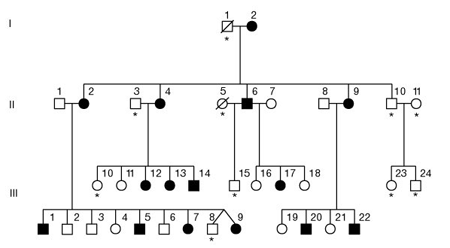
The FOXP2 gene was first identified through the study of the so called "KE family" in the late 90s. This is a family in which a severe speech and language disorder affects almost half of the members. This case was interesting because the disorder segregated from generation to generation in a pattern that pointed very decisively towards there being just one gene causing it. You can see a pedigree of the KE family below. Shaded symbols indicate affected individuals.


Ref: S.E. Fisher et. al (see reference below)

The researchers were able to identify the region on chromosome 7 that was associated with the speech disorder and subsequently they were able to identify the gene. Even though FOXP2 should not by any means be called "the speech gene", its identification and study has given us an "entry way" into the very complex processes that govern speech and ultimately perhaps language.

These are the questions I prepared for the seminar with my own answers, adapted for an undergraduate biology crowd.

1. What is the function of the FOXP2 gene product? How does it act?

FOXP2 is a transcription factor, a protein that binds to DNA and regulates the expression of a variety of specific genes. In the case of FOXP2 it's still unknown which ones. FOXP2 in particular represses the expression of genes. The fact that it's a transcription factor puts it in a place of particular interest for several reasons. (1) It makes it probable that it's central to the processes that underlie speech. (2) Small changes in a transcription factor can give rise to major innovations because they influence a wide variety of genes and thus functions. (3) Transcription factors have dual roles - they act during development, setting up structures and functions, as well as in the mature organism, regulating the same. This mirrors the complex development and plasticity of speech.

2. FOXP2 is an extremely conserved gene in vertebrates. What does this mean? Can you relate this fact to the FOXP2 protein function?

The word conserved means that there is very little sequence diversity between lineages. In other words, there is extremely little difference between the crocodile FOXP2, chicken FOXP2 and human FOXP2. Transcription factors are generally more conserved since they have a very basic function - even the smallest change could have enormous consequences since transcription factors regulate a wide variety of genes and functions, but also because they act during development.

3. FOXP2 was related to speech by the study of individuals with speech abnormalities (particularly the KE family). How are their FOXP2 genes aberrant?

The KE family has a substitution from arginine to histidine on position 553. This affects the DNA-binding region of the protein, leaving it useless. Another patient has a premature stop codon that leaves the protein too short to function and yet another patient has a translocation in the region containing the gene.

4. Why is it useful to study FOXP2 in vocal learning birds and bats? What are the main findings in this regard?

The implication of FOXP2 in brain regions involved in bird song learning are considered parallel to the human vocal learning of language. Young birds, just like us, mimic the sounds that adults make in order to learn them. It has been found that FOXP2 expression is increased in periods of song learning. These seasonal periods of plasticity could mirror the development of the neural circuits that make vocal learning possible. However no specific mutations have been related to this specific ability (including the study of vocal learning echolocating bats) and expression sites of FOXP2 are not different when comparing vocal learners with non-vocal learners.

5. In which brain regions is FOXP2 expressed? To what faculties of speech and language can you relate FOXP2 expression?

FOXP2 is expressed in similar and partly overlapping regions in all vertebrates studied, mainly in cerebellar and basal ganglia circuits. Regions include the lateral ganglionic eminence in the developing brain which gives rise to the striatal medium spiny projection neurons, involved in planning and modulation of movement; thalamus, in particular the regions that receive input from the basal ganglia; the inferior olives, which are part of the cerebellar motor learning and function; cerebellar Purkinje cells and deep cerebellar nuclei as well as sensory auditory midbrain structures. These regions implicate FOXP2 in the fine sensorimotor coordination/integration which underlies the sequenced behavior and learning behind speech and language.

FOXP2 is not expressed in the structures that form the trigeminal sensorimotor circuit that controls orofacial movements. So FOXP2 apparently has nothing to do with the control of the movements of the mouth and lower face, but rather with the coordination, planning and learning of these movements.

6. How is the human FOXP2 gene different from that of our closest extant relative the chimpanzee? What consequence does this have for the human FOXP2 protein function?

The human FOXP2 gene has two characteristic amino acid substitutions in exon 7 compared to the chimpanzee gene - a threonine to asparagine substitution in position 303 and an asparagine to serine substitution on position 325. The latter substitution leads to a hypothetical target site for protein kinase C and a minor structural change. Phosphorylation of transcription factors is an important way of regulating gene expression. Even this small difference between humans and chimpanzees could lead to a dramatic change in the regulations of the variety of genes that are under the control of FOXP2.

7. Has the human FOXP2 gene been under any selective pressure? How can we see this?

It seems as though the human FOXP2 gene has been under recent positive selection rather than relaxed negative selection. This means that whatever changes the human-specific mutations caused, they gave significant benefits to the individuals that carried them. This could be seen by studying the FOXP2 gene sequences in mouse, great apes and human and comparing non-synonymous substitutions, mutations that change the amino-acid sequence of the protein, with synonymous substitutions, mutations that don't.

8. The Neanderthal FOXP2 gene seems to be identical to that of modern humans. With other primates in mind, what consequences does this have for the expansion of modern humans?

This is a very big and very open discussion that in the end is more speculative than anything, albeit based on actual scientific findings. The question seems to be whether or not the emergence of a complex language lead to our cultural and therefore geographical and demographical expansion? It's definitely tempting to draw the conclusion that we became so successful because we evolved a language that allowed us to cooperate between individuals like never before. The human-specific mutations in FOXP2 may very well have been a pivotal point in this development. If Neanderthals had the same FOXP2 sequence as us modern humans, it's probable that they possessed many of the same faculties of language and culture that we do. Maybe at one time in history we understood each other?

9. In what way is FOXP2 special in echolocating bats? Can this provide any clues with regards to FOXP2 function? Can this be contrasted to FOXP2 in echolocating whales?

FOXP2 has diverged more in echolocating bats than any other group of vertebrates. This further implicates FOXP2 in sensorimotor coordination and vocal learning, which are requirements for echolocation. The same pattern could not be seen for echolocating whales, presumably because their echolocation is mediated through their foreheads and would not require sensorimotor coordination of their mouth and face.

10. Using what you have learned about FOXP2 in humans, birds, bats, whales and other animals, what can you say about the evolution of vocal communication and language? Is language a uniquely human feature?

This is yet another very big and very open discussion. Arguably, many animals possess some of the faculties of our speech and language. Most animals vocalize, for instance, even though it's only growls, barks, meows, shrieks, squeaks et.c. As we've seen, some learn their complex vocalization patters by mimicking adults, just like we do, and some even have more complex systems where different sounds are connected to different meanings. A few species of monkeys can distinguish between different predators and warn their fellow group-members accordingly.

But is this language then?

I would say no. The best definition I know of language is "the ability to produce infinite meaning from a finite sent of sounds or symbols", and this is clearly a human-specific feature, as far as our best knowledge goes. With our language we are able to describe not only that which we can sense, but also a wide spenctrum of things we cannot sense at all! Even things that are completely invented. We use language not only for utility but also creatively to make things up. We can even make up words that have no meaning attached to them.

Still, the fact that other animals possess some faculties of speech is significant because it firmly bases our unique adaptation of language and culture within natural processes by showing that a stage was already set from which a few genomic events could lead to our advanced use of vocalization.

Swedish blog tags: , , ,
Technorati tags: , , , ,

Scharff, C., Haesler, S. (2005). An evolutionary perspective on FoxP2: strictly for the birds?. Current Opinion in Neurobiology, 15(6), 694-703. DOI: 10.1016/j.conb.2005.10.004

Enard, W., Przeworski, M., Fisher, S.E., Lai, C.S., Wiebe, V., Kitano, T., Monaco, A.P., Pääbo, S. (2002). Molecular evolution of FOXP2, a gene involved in speech and language. Nature, 418(6900), 869-872. DOI: 10.1038/nature01025

Krause, J., Lalueza-Fox, C., Orlando, L., Enard, W., Green, R., Burbano, H., Hublin, J., Hänni, C., Fortea, J., de la Rasilla, M., Bertranpetit, J., Rosas, A., Pääbo, S. (2007). The Derived FOXP2 Variant of Modern Humans Was Shared with Neandertals. Current Biology, 17(21), 1908-1912. DOI: 10.1016/j.cub.2007.10.008

Li, G., Wang, J., Rossiter, S.J., Jones, G., Zhang, S. (2007). Accelerated FoxP2 Evolution in Echolocating Bats. PLoS ONE, 2(9), e900. DOI: 10.1371/journal.pone.0000900

Fisher, S.E., Vargha-Khadem, F., Watkins, K.E., Monaco, A.P., Pembrey, M.E. (1998). Localisation of a gene implicated in a severe speech and language disorder. Nature Genetics, 18(2), 168-170. DOI: 10.1038/ng0298-168

Cecilia S. L. Lai, Simon E. Fisher, Jane A. Hurst, Faraneh Vargha-Khadem, Anthony P. Monaco (2001). A forkhead-domain gene is mutated in a severe speech and language disorder Nature, 413 (6855), 519-523 DOI: 10.1038/35097076

March 02, 2008

Brief report

The last few weeks have been a bit hectic. Aside from trying my best to keep up with my research, I've taken the mandatory research ethics and philosophy of science graduate course as well as prepared and carried out an electrophysiology computer lab and a literature seminar for the neurobiology undergraduate course (which was great fun). I've also gotten some reading done, not only on new exciting articles, but also on Evolution by Douglas Futuyma, which we're analyzing as a sort of literature course in my department. So I've been busy, busy, busy which isn't really a problem 'cause I like it that way. But it means that the rest of my retort to the creationist lecture will have to wait until I find some time to finish it. Most of it is done but I don't want to break it down even more than it is.

What makes things a bit difficult is that I seem to have contracted a rather bothersome ear infection in my right ear. Fortunately it hasn't managed to keep me in bed all day (only when the ache and the fever and the swollen throbbing lymph-nodes were too tiresome to handle) and I am feeling much better now, even though my ear and throat still hurt.