November 28, 2007

Brainbow


Ref: http://olympusbioscapes.com/gallery/2007/index.html

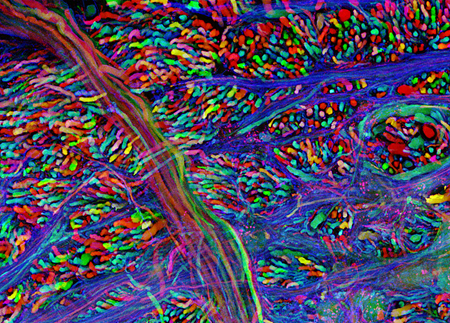
ResearchBlogging.orgBeautiful isn't it? This award winning picture shows the brain stem of a transgenic mouse that has been modified using an exciting new technique called Brainbow. The mouse has been modified to express 4 different fluorescent proteins randomly in different neurons.

Much like pixels make many different colors possible on your screen, the different random combinations of green, red, cyan and orange fluorescent proteins make it possible to color individual neurons in nearly 100 different hues. You never know from the beginning which color every individual neuron is going to get, but with a choice of nearly 100 different possibilities chances are you're going to observe every individual neuron glow in a different hue, making it possible to chart complex neuronal pathways.
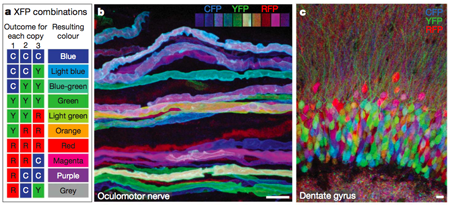

Ref: J. Livet et. al (see reference below)

The use of fluorescent proteins is an important technique to visualize for instance where different genes are being expressed. The gene that encodes the fluorescent protein, first found in jellyfish, can be introduced next to the gene of interest in the transgenic animal. Then both genes are going to be expressed at the same time and you can get a marker of what organ or what part of the brain your gene of interest is being expressed. It's simply going to glow in the dark.

Livet, J., Weissman, T.A., Kang, H., Draft, R.W., Lu, J., Bennis, R.A., Sanes, J.R., Lichtman, J.W. (2007). Transgenic strategies for combinatorial expression of fluorescent proteins in the nervous system. Nature, 450(7166), 56-62. DOI: 10.1038/nature06293

Swedish blog tags: , , , ,
Technorati tags: , , , ,

November 24, 2007

On the Origin of Species: still going strong

On this day 148 years ago, November 24 1859, On the Origin of Species by Charles Darwin was first published. The just over 1000 copies of the first edition were sold out on the same day. Over the course of these 148 years new knowledge has been added and of course some of Darwin's propositions have been reviewed as science progresses. But at its core, his theory of evolution still holds true. That all life has a common origin and that over the course of innumerable generations living organisms have changed and adapted, generating the wonderful variety that we observe today. A variety that, although awesome in our eyes, is only a speck of all life that has ever existed and will ever exist. The very last words in On the Origin of Species are:

There is grandeur in this view of life, with its several powers, having been originally breathed into a few forms or into one; and that, whilst this planet has gone cycling on according to the fixed law of gravity, from so simple a beginning endless forms most beautiful and most wonderful have been, and are being, evolved.


It's a powerful idea that not only serves scientific progress; it has the power to inform all of our individual existences with clarity and reason instead of obscurity and mysticism. One would think that after so many years, more people would have realized its worth and taken it to heart.

The above quote from the book is probably one of the better known ones... deservedly I should add. But I think my favorite part is from the last page of the introduction.

No one ought to feel surprise at much remaining as yet unexplained in regard to the origin of species and varieties, if he makes due allowance for our profound ignorance in regard to the mutual relations of all the beings which live around us. Who can explain why one species ranges widely and is very numerous, and why another allied species has a narrow range and is rare? Yet these relations are of the highest importance, for they determine the present welfare, and, as I believe, the future success and modification of every inhabitant of this world.


Swedish blog tags: , , , ,
Technorati tags: , , , ,

November 23, 2007

It's bad luck to be superstitious

>> Re-post from January 24, 2007.

I saw an article through scienceblogs.com this morning that I thought was interesting and thoughtworthy and really cool. It's called Magical Thinking: Why Do People Cling to Odd Rituals. Even Diesel Sweeties, mentions it. Apparently the belief that your own thoughts can affect the physical world is very common and easy to elicit experimentally.

Read the article with a pinch of salt though.

The appetite for such beliefs appears to be rooted in the circuitry of the brain, and for good reason. The sense of having special powers buoys people in threatening situations, and helps soothe everyday fears and ward off mental distress. In excess, it can lead to compulsive or delusional behavior. This emerging portrait of magical thinking helps explain why people who fashion themselves skeptics cling to odd rituals that seem to make no sense, and how apparently harmless superstition may become disabling.


It's interesting to think that our brains accept a magical interpretation to a series of events or situations in the absence of a rational explanation, but where the author of the article is very quick to see purpose I see a side-effect of our imaginative and creative brain. The ability to make quick judgments about causation and form hypotheses quickly, even before logical thinking, is something I judge to have been very helpful in our evolution as well as our development into adults. So in my opinion, any propensity towards magical thinking, or religion, doesn't really have a "purpose" of its own, but is rather an interesting property of our mental abilities, a by-product of the abilities that have been advantageous in our evolution. Which makes the following statement even more bewildering...

If the tendency to think magically were no more than self-defeating superstition, then over the pitiless history of human evolution it should have all but disappeared in intellectually mature adults.


Frankly, I can't figure out what that's even supposed to mean.

Even though I'm sure we all know that feeling of security from "positive omens" and so on, most sound people don't walk around actually believing that our thoughts can affect the outcome of events independent from us. At least that's what I hope.

Swedish blog tags: , ,
Technorati tags: , ,

November 15, 2007

New job status

I signed my work contract this Tuesday, finally, and today I got my copy of it back signed by both my supervisor and the prefect of the department. I'm officially a PhD student in medical sciences now. I was accepted on October 30 but today everything was finalized.

I checked the Uppsala Universitet online staff catalog just in case and sure enough, there I am.

November 11, 2007

Yet here you are

You are the result of an unbroken chain of organisms that were successful in surviving long enough to reproduce. An unbroken chain. Do you realize how unlikely this is? Over the billions of years that life has evolved on this planet, billions, there is a perfect unbroken line between that first speck of life, whatever it may have been, and you. I think that at the heart of this fact lies the power that evolution can have in informing your individual existence.

The vast majority of lineages, let's call them species, that have ever lived are now extinct. Not only that; the vast majority of species that will ever live will go extinct. In a way, the most natural of all organisms is a dinosaur, in a metaphorical sense of course, since the most natural thing for any species to do is to die out. We have a mass of unquestionable evidence that enables us to say that this is true. If it were not, there would be no evolution.

Yet here you are! As unlikely as you are, you are here nonetheless. This is a wonderful and awe-inspiring thought, and one that fills us with life-affirming gratitude. After all, the privilege of living is to be preferred over the possibility of never having existed at all. But before your own unlikelihood makes you feel uniquely special (or specially unique) or even that you are here purposefully, consider this question -- where else would you be?

You are the result of a perfect unbroken chain of organisms that through an evolutionary history extends back to the origin of life itself, that's true, but where else would you be to be able to ask yourself why this is?

Nowhere else but here.